
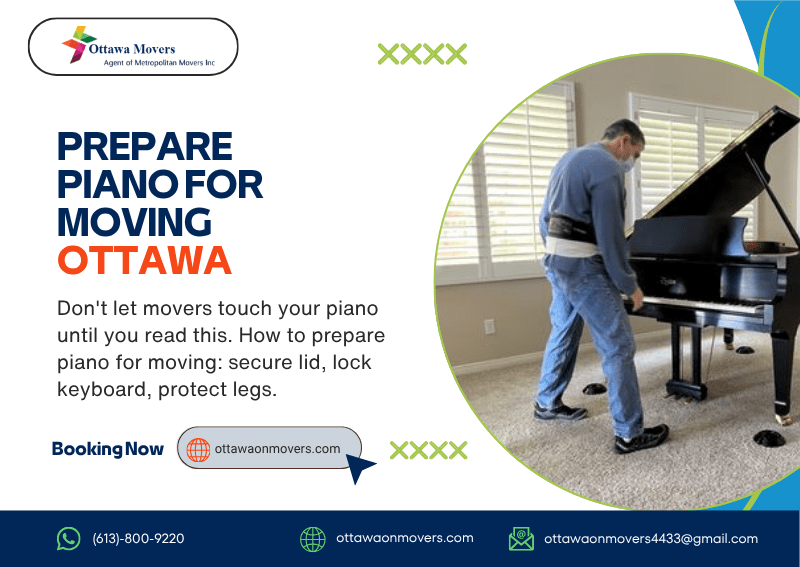
Moving day is approaching. You’ve booked the movers, packed the boxes, and confirmed the new home. But there’s one item that still makes you pause: the piano. Do you leave it as it is? Is there anything you should do before the professionals arrive? Should you try to “help” by wrapping it yourself?
Proper preparation is essential to protect your piano during the move and ensure the process goes smoothly. A piano isn’t like a sofa or a dining table—it’s a delicate instrument with moving parts, a sensitive soundboard, and a finish that can be damaged by the wrong tape or careless handling. The right preparation can make the difference between a smooth, damage‑free move and costly repairs.
This guide covers exactly how to prepare your piano for moving—from securing the lid and clearing the path to documenting the piano’s condition and avoiding common mistakes. For nearly five decades, Ottawa Movers has helped Ottawa residents move their pianos safely. With 48+ years of experience, over 23,000 successful moves, CAM‑trained crews, and a Damage‑Free Guarantee backed by $1.5 million in insurance, we handle the heavy lifting—but your preparation on the front end ensures the best possible outcome.
Knowing how to prepare your piano for moving can make the difference between a smooth move and costly damage.
For a complete overview of the moving process, see our piano moving process guide .
Why Proper Piano Preparation Is Essential
Pianos are not ordinary furniture. They are complex instruments with thousands of moving parts, a fragile soundboard, and a finish that can be marred by the wrong materials. Proper preparation:
- Prevents damage – protects the soundboard, strings, case, and moving parts.
- Saves time – movers can work efficiently when the piano is ready and the path is clear.
- Ensures safety – reduces the risk of injury to movers and anyone nearby.
- Protects your home – prevents scratches, dents, and other property damage.
Even professional movers like Ottawa Movers rely on clients to handle certain pre‑move tasks. We bring the specialized equipment and trained crews, but you know your home and your piano best. A little preparation on your part goes a long way.
Piano moving preparation Ottawa starts with you – and professionals finish the job.
See our full piano moving checklist for everything you need to do.
Step 1: Clear the Path
The path from the piano to the exit needs to be completely clear. Movers need unobstructed access to manoeuvre the piano safely.
- Measure doorways, hallways, and stairwells – ensure the piano can fit. If you’re unsure, Ottawa Movers will measure during the in‑home assessment.
- Remove obstacles – chairs, rugs, plants, and other furniture should be moved out of the way.
- Secure pets and children – keep them in a separate room during the move for their safety and to avoid distractions.
- Note any tight spots – inform the movers in advance about narrow turns, low ceilings, or tricky staircases.
A clear path helps keep the timeline on track. See how long a piano move takes .
Step 2: Secure the Lid and Keyboard
The lid and keyboard are two of the most vulnerable parts of a piano during a move. If they’re not secured, they can swing open, causing damage to the piano or injury to the movers.
For upright pianos:
- Close the lid completely.
- If your piano has a built‑in lock, use it. If not, the movers will secure the lid with straps and padding.
- Do not use household tape directly on the piano finish—it can leave residue or damage the wood.
For grand pianos:
- Close the lid and secure it with the built‑in lock if available.
- The fallboard (the keyboard cover) should be closed and locked.
- Do not attempt to remove the legs yourself. Grand piano legs require specialized knowledge and tools. Ottawa Movers handles this step safely.
How to secure piano for moving Ottawa starts with protecting the lid and keys.
Step 3: Protect the Piano with Padding
Professional movers bring the right padding materials. You do not need to wrap the piano yourself—in fact, using the wrong materials can do more harm than good.
What professionals use:
- Clean, furniture‑grade moving blankets
- Shrink wrap (not household plastic)
- Corner protectors for edges
What not to use:
- Household blankets (may slide off or shed fibres)
- Duct tape or packing tape (can leave residue or damage finish)
- Bubble wrap directly on wood (may trap moisture)
Your role is simply to ensure the piano is accessible so the movers can wrap it efficiently.
Piano packing tips Ottawa include trusting professionals with the wrapping.
Add “inspect padding” to your piano moving checklist .
Step 4: Remove Accessories and Loose Items
Anything that is not part of the piano’s structure should be removed and moved separately. Loose items can fall, break, or cause scratches during transport.
Remove these items:
- Music stand – remove and wrap separately.
- Bench – move separately (if it doesn’t attach to the piano).
- Metronome, sheet music, lamps – pack these in boxes.
- Ornaments on top – remove entirely.
Moving these items separately also protects them from being damaged by the piano’s weight or movement.
Do I need to prepare piano before moving Ottawa? Yes – starting with accessories.
Step 5: Notify Building Management
If your move involves an apartment, condo, or managed building, you need to coordinate with building management in advance.
- Book the elevator – reserve a time slot, especially if the building has a service elevator that requires advance notice.
- Arrange parking – reserve a spot for the moving truck. In downtown Ottawa, this is essential.
- Obtain permits – some buildings require moving permits or proof of insurance.
- Inform neighbours – a courtesy notice can prevent complaints and smooth the way for the movers.
Ottawa Movers can assist with coordinating, but you should initiate the process to ensure everything is in place.
Prep piano for movers Ottawa includes managing building logistics.
Add “building arrangements” to your piano moving checklist .
Step 6: Document the Piano’s Condition
Taking photos or videos of your piano before the move is a simple step that can save you headaches later.
What to document:
- Overall condition – full piano photos from multiple angles.
- Close‑ups – of any existing scratches, marks, or damage.
- Serial number – for insurance purposes.
Why? Documentation helps establish the piano’s condition before the move. Ottawa Movers has a zero‑claim record, but it’s still good practice. If there’s ever a question about whether damage occurred during the move or existed before, you have clear evidence.
How to prepare a piano for moving Ottawa includes protecting yourself with documentation.
Step 7: Communicate with Your Movers
Clear communication before moving day ensures everyone is on the same page.
- Share any concerns – let the movers know if the piano has sentimental value, if there are fragile spots, or if you’re worried about a specific part of the move.
- Confirm the plan – where will the piano be placed in the new home? If there are multiple options, discuss them in advance.
- Provide contact information – make sure you’re reachable on moving day.
Ottawa Movers conducts an in‑home assessment to discuss these details, but a final check before the move is always helpful.
Piano moving preparation tips Ottawa always include talking to your movers.
Good communication helps keep the piano moving timeline on track.
Step 8: What NOT to Do When Preparing a Piano for Moving
Just as important as what you should do is what you should avoid. These common mistakes can lead to costly repairs.
- Do NOT attempt to remove grand piano legs yourself. This requires specialized knowledge and tools. Leave it to the professionals.
- Do NOT use household tape on the piano finish. Duct tape, packing tape, and masking tape can leave residue or damage the wood. Professional movers use specialized materials.
- Do NOT move the piano with items on top. Ornaments, lamps, or sheet music can fall and cause scratches or more serious damage.
- Do NOT try to “help” lift. Let trained movers handle the heavy work. Well‑intentioned helpers can get in the way or cause accidents.
- Do NOT store anything on the piano during the move. Keep the piano clear and accessible.
Knowing how to prepare a piano for moving Ottawa also means knowing what to avoid.
Avoid these common mistakes—see our hidden piano moving costs guide for more.
Let Ottawa Movers Handle the Heavy Work – You Focus on Preparation
Knowing how to prepare your piano for moving ensures a smooth, damage‑free experience. When you do your part—clearing the path, removing accessories, documenting condition—you give professional movers the best possible conditions to work efficiently and safely.
With Ottawa Movers, you get 48+ years of local experience, CAM‑trained professional crews, specialized piano equipment, and a Damage‑Free Guarantee backed by $1.5 million in insurance. We handle the heavy lifting so you can focus on settling into your new home.
Get your free, no‑obligation in‑home assessment today. We’ll assess your piano, discuss your move, and give you a clear, transparent quote—so you know exactly what to expect.
[Get Your Free Piano Moving Quote]
FAQs About Preparing a Piano for Moving
Do I need to prepare my piano before professional movers arrive?
Yes. Clear the path, remove accessories, secure the lid, and document the piano’s condition. The movers handle the rest—including wrapping, leg removal, and loading.
Should I remove the legs of my grand piano myself?
No. Leg removal requires specialized knowledge and tools. Ottawa Movers handles this safely.
What packing materials do I need to provide?
None. Ottawa Movers brings all necessary padding, blankets, straps, and protective materials. Do not attempt to wrap the piano yourself with household materials.
How do I secure the lid of an upright piano without a lock?
Leave this to the professionals. Ottawa Movers uses straps and padding to secure the lid without damaging the finish. Do not use household tape.
What should I do if my piano is in a basement or upper floor?
Inform the movers during the in‑home assessment so they can bring the right equipment (stair rollers, extra crew members) and plan accordingly.