
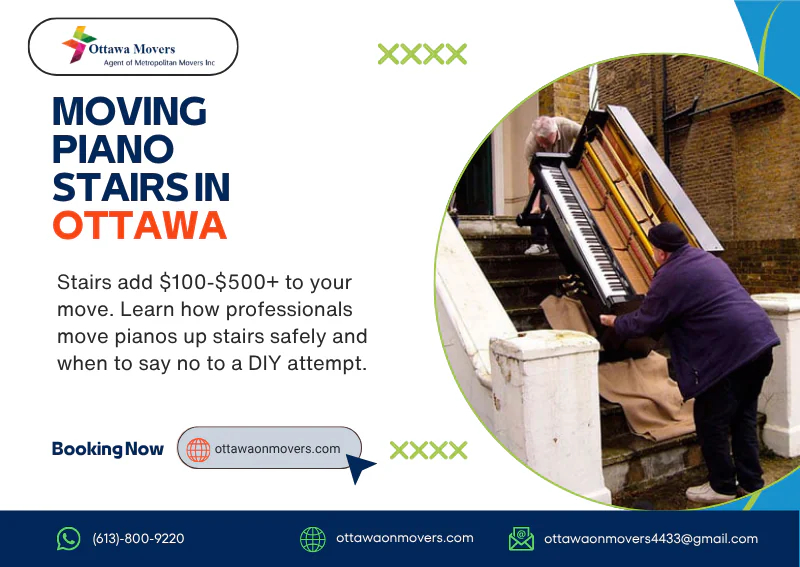
Ask any piano mover what they fear most, and the answer will almost always be the same: stairs. Moving a piano up or down a flight of stairs is one of the most dangerous and complex tasks in the moving industry. A tipping piano on stairs can cause severe injury, permanent damage to the instrument, and destruction of the staircase itself.
Yet stairs are a reality for many piano owners. Whether your piano is in a basement, a second‑floor apartment, or a downtown Ottawa walk‑up, it has to come out—or go in—via the stairs. The key is knowing that moving piano stairs is never a DIY project and understanding how professionals do it safely.
This guide covers the risks, the professional process, the costs, and why you should never attempt a stair move on your own. For nearly five decades, Ottawa Movers has been safely moving pianos on stairs across Ottawa. With 48+ years of experience, CAM‑trained crews, specialized stair‑rolling equipment, and a Damage‑Free Guarantee backed by $1.5 million in insurance, we’ve seen—and solved—every stair challenge this city has to offer.
Moving piano stairs is never a DIY project – here’s why.
For an overview of other challenging moves, see our challenging piano moves guide .
Why Stairs Are the Biggest Risk Factor
Stairs change everything about a piano move. The physics alone make it exponentially more dangerous than moving on a flat surface.
The physics of stairs:
- When a piano is tilted on stairs, its effective weight increases because the load is concentrated on a smaller surface area.
- A piano tipping on stairs gains momentum quickly, making it nearly impossible to stop.
- Narrow staircases leave no room for error—there’s nowhere to move aside if the piano starts to fall.
The risks:
- Dropped piano: A piano that tips on stairs will likely be a total loss. Repairs often cost more than the instrument’s value.
- Serious injury: A piano falling on stairs can crush toes, break bones, or cause life‑threatening injuries.
- Property damage: Staircases can be destroyed, walls can be punctured, and railings can be ripped out.
- Strained relationships: If friends or family are helping, an accident can cause lasting emotional and financial strain.
Risks moving piano on stairs Ottawa are too high for amateurs.
See why DIY is not safe for stairs in our DIY vs professional piano movers guide.
How Professionals Move Pianos on Stairs – Step by Step
Moving a piano on stairs is not about brute force; it’s about technique, teamwork, and the right equipment. Here’s how a professional crew like Ottawa Movers handles it.
Step 1: Assessment
Before moving day, the crew visits the home to measure the staircase. They note:
- Width of the stairs
- Number of steps
- Presence of a turn or landing
- Condition of the staircase (sturdy? narrow? carpeted?)
Step 2: Equipment Preparation
The crew brings specialized stair rollers—heavy‑duty rollers that attach to the piano’s skid board. These allow the piano to glide smoothly over each step without catching or scraping. They also bring extra padding to protect the walls and banisters.
Step 3: Piano Preparation
The piano is wrapped in moving blankets and secured with straps. The lid is locked or strapped closed. For grands, the legs are removed and the piano is placed on a skid board.
Step 4: Crew Positioning
Depending on the piano size and the staircase, the crew positions three to five movers:
- One or two at the top, controlling the piano with straps
- One or two at the bottom, guiding the rollers
- One at the side, watching for obstacles
Step 5: Controlled Movement
The piano is tilted onto the stair rollers. The crew moves it step by step, with frequent pauses to check stability. Every movement is communicated verbally: “stop,” “go,” “left,” “right.” The pace is slow and deliberate—there’s no rushing on stairs.
Step 6: Landings and Turns
If the staircase has a landing, the crew carefully rotates the piano using the rollers and additional padding. This requires precise coordination to avoid damaging the walls or the piano.
Step 7: Completion
Once the piano is off the stairs, it’s moved onto a dolly for the rest of the journey. The crew then inspects the staircase, walls, and piano for any marks or damage.
Piano stairs moving safety Ottawa relies on proper technique and equipment.
Stair moves add time to the overall move. See our how long a piano move takes guide for timeline estimates.
Cost of Moving a Piano with Stairs – What to Expect
Stairs are one of the most common add‑on fees in piano moving—but with Ottawa Movers, they are always quoted upfront. There are no surprises.
Here are typical cost ranges for stairs:
| Stairs | Additional Cost |
| 1 flight | $100 – $200 |
| 2–3 flights | $200 – $400 |
| 4+ flights or spiral stairs | $400 – $600+ |
These are on top of the base piano moving cost. The exact amount depends on:
- The piano type (grand pianos cost more per flight)
- The number of stairs per flight
- The turn radius (tight turns add complexity)
- Whether the stairs are indoor or outdoor
For a full breakdown of base moving costs, see our average piano moving cost guide.
Piano moving up stairs Ottawa costs are always quoted upfront.
When to Say No – DIY Stair Moves Are Never Safe
I cannot emphasize this enough: two people should never move a piano on stairs. Even with four helpers, the lack of proper equipment and training makes it extremely dangerous.
What can go wrong:
- The piano tips: Even a slight imbalance can cause the piano to fall. Once it starts, it’s almost impossible to stop.
- Strap failure: Regular straps are not designed for stair moves. They can slip or break under the weight.
- Injury: A falling piano can crush feet, break bones, or send helpers tumbling down the stairs.
Real‑world example: Last year, an Ottawa resident attempted to move an upright piano down a basement staircase with three friends. They used a furniture dolly and household straps. Halfway down, the dolly slipped, and the piano tipped. The result: $2,800 in piano repairs, a broken railing, and a trip to the emergency room for one helper. The piano ended up being moved by professionals anyway—after the damage.
Accidents moving piano stairs Ottawa are common – and preventable.
Read do you really need a piano mover for more scenarios where professionals are essential.
Don’t Risk Stairs – Trust Ottawa Movers
Stairs are the single greatest risk in piano moving. They demand specialized equipment, a trained crew, and years of experience. When you hire Ottawa Movers, you’re getting a team that has safely moved thousands of pianos up and down stairs across Ottawa—including the narrowest, trickiest staircases this city has to offer.
Get your free, no‑obligation in‑home assessment today. We’ll assess your staircase, discuss the best approach, and give you a clear, transparent quote with no surprises.
[Get Your Free Stair Piano Move Quote]
FAQs About Moving Pianos on Stairs
Can a piano be moved up a narrow staircase?
Yes, with the right technique. Ottawa Movers uses stair rollers and skilled crews to navigate even the tightest staircases. The key is a thorough assessment beforehand.
How many movers are needed for a piano on stairs?
At least three to five, depending on the piano size and the staircase. A grand piano on a narrow stairwell may require five or more.
Does moving a piano up stairs cost more than down?
Typically similar—both require the same equipment, crew size, and technique. The cost depends primarily on the number of flights and the difficulty of the staircase.
What if my staircase has a turn or a landing?
Professionals will assess the turn and plan the best approach. Sometimes the piano must be rotated on the landing using rollers and additional padding.
Is it safe to move a grand piano on stairs?
Yes, with proper equipment and crew. Ottawa Movers has extensive experience moving grands on stairs. The legs are removed, and the piano is placed on a skid board with stair rollers.